Hohsalle—Yotalu
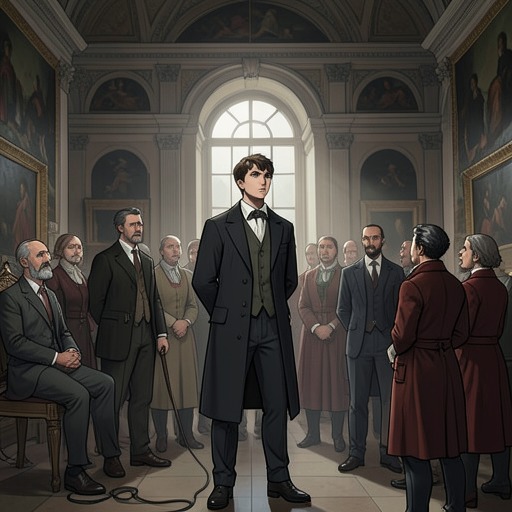
The Deer KingHohsalle and Yotalu form a working alliance in the investigation of the disease called black wolf fever, grounded in Yotalu’s trust in medical inquiry and Hohsalle’s insistence that uncertainty must be faced before conclusions are drawn. Their relationship links clinical investigation to political responsibility: Yotalu can secure permission and cooperation, while Hohsalle brings expertise and a commitment to saving lives that he places above national divisions.
Positions and First Cooperation
Yotalu is Governor Ohan’s second son, described as intellectually disposed. When the investigation was still at an early stage, he pressed Hohsalle for an update but accepted the physician’s correction that the disease had not yet been diagnosed. Hohsalle acknowledged that he had spoken the previous day as if the diagnosis were settled; the records were ancient, and other illnesses still had to be ruled out. This exchange establishes a relationship in which Yotalu seeks answers but allows Hohsalle to qualify what the available evidence can support.
Yotalu then relayed a response from his father and elder brother, Utalu, who had departed for a conference with the emperor in the capital but were still near Kazan. Though Yotalu said he himself had known nothing about black wolf fever, they understood its dangers and warned that a mistake in handling it could bring disaster. They urged consultation with Hohsalle. Yotalu’s role was not simply to request a medical opinion: he connected the physician’s investigation to the authority and judgment of the provincial leadership.
Trust, Permission, and Shared Action
Hohsalle had intended to inform the Sacred Territory about the outbreak and ask for advice, but had waited for Governor Ohan’s permission before sending a message. Yotalu removed that obstacle. He said that his family would welcome Otawalle’s support because they knew little about the disease, and reported that Lona shared this view and had advised him to consult Hohsalle first. He further explained that his father would tell the court priest-doctors because of the urgency, while he and Utalu could manage that discussion diplomatically and heed the emperor. In the meantime, Governor Ohan had directed Yotalu to follow Hohsalle’s instructions and asked the physician to share the Academy of Deeper Learning’s knowledge.
That support became practical when Hohsalle proposed joining Tohlim to seek help from Malji, the chief of the Aquafa slave trackers. Hohsalle was willing to leave while examination of the bodies continued, reasoning that the results would take several days and that removing the corpses from the mine would itself take at least a day or two. Yotalu accepted the plan. His permission mattered because Hohsalle was moving beyond the immediate investigation and into a search for people who could help identify the disease’s animal carriers.
The decision also exposed what each man believed the physician’s role required. Hohsalle told Yotalu that infection did not determine who would survive: no one could predict who would succumb and who would live. Kingdoms and nations, he said, were irrelevant to disease, and he had sworn to devote his life to saving people. Yotalu understood the declaration and urged him to go, saying that if anyone could save the land from black wolf fever, it was Hohsalle. His trust thus encompassed not only Hohsalle’s skill but his choice to pursue the task without letting other concerns distract him.
Reasoning Against Rumor
Their alliance operated amid uncertainty about how the disease spread. Hohsalle cautioned Yotalu that it was still too soon to identify the illness, even as he reasoned from the salt mine victims’ apparent near-simultaneous exposure and deaths. The disease seemed highly virulent, yet people working at the mine after the incident had not become ill. Hohsalle therefore judged that infection was unlikely to be wind-borne or carried by fleas or ticks at that stage, and that bites from an animal were the likelier route. Yotalu followed the argument to its practical consequence: instead of indiscriminately hunting wild dogs or wolves, they needed to identify which animals carried the disease. Hohsalle agreed, noting that if wolves or ossam had attacked the sheep, shepherds bitten by them should also have fallen ill; Yotalu treated that absence as evidence worth investigating.
Later, the investigation met a more politically charged question. After Utalu’s death, the rumor that only Aquafaese survived black wolf fever had spread in Kazan, and Governor Ohan asked Hohsalle whether the claim was true. Hohsalle answered cautiously: the disease had not been definitively identified, and there was no proof that Aquafaese were immune. The cases he cited complicated the rumor. Izam’s symptoms had been more serious than those of Olimu, who was half Zolian, and Limuelle’s drastic measures had been needed to save Olimu. Hohsalle therefore warned that the disease could kill Aquafaese too. The distinction between a claim and a finding was central to his approach, and Yotalu’s earlier willingness to consult him had helped make that approach possible.
Hohsalle also warned that believing Aquafaese immune could make them less cautious around infected animals. He feared the disease might change as more people became exposed: if it behaved like black wolf fever, warmer weather and increasing flea and tick populations could allow insects that had fed on infected people or animals to spread it more widely. In his view, the risk of an epidemic demanded more attention than the politically convenient rumor. The account shows their shared work extending beyond diagnosis: the evidence had to inform precautions before speculation shaped behavior.
A Wider Inquiry and Unresolved Stakes
The political consequences of treatment sharpened the same conflict. Hohsalle argued that Aquafaese without resistance might also die, but could potentially be saved by medicine made from weakened disease agents. If Zolians could not be inoculated, however, the illness could appear to threaten only them. People might then interpret Zolian deaths as divine will and call the disease the Curse of Aquafa. Hohsalle’s reasoning identified a danger in both the medical and political aftermath: treatment could save lives, while uneven access or refusal could be absorbed into a divisive religious explanation.
He therefore emphasized the need to understand why susceptibility varied. The Zolian falconer bitten near the chin had developed severe symptoms especially quickly, while Sulumina had shown the greatest resistance, followed by Mazai and Olimu. Hohsalle wanted to know why the disease had not apparently emerged in remote mountain regions where black wolves had once been abundant, but acknowledged that surveying all of Aquafa and gathering evidence from nomadic clans would take too long. Yotalu’s response that it might be possible opened a path beyond the limits Hohsalle had identified.
That inquiry later drew on a map assembled from information gathered by Tomasolle and Cheehana. Hohsalle was surprised to see cases of mittsual-like symptoms distributed across the former Kingdom of Aquafa, from the Yukata Plains in the south to the Oki forests in the north, including an incident near the place where Makokan pursued a fugitive. The oldest reported case reached back eight years, well before the salt mine incident. Yet the accounts described separate attacks by wolves or ossam, usually with only one or two people affected and no reported onward spread. Hohsalle reasoned that this pattern was unnatural if bites transmitted the infection: pack-living wolves should have produced further cases, and several years of warm seasons should have allowed ticks and mosquitoes to multiply. He called for an explanation of what was preventing spread.
The investigation remained open rather than resolving into a single answer. Cheehana suggested that host animals might not stay in one place long enough to pass the disease to ticks, while Tomasolle raised the further question of how dogs and wolves across such a broad area had acquired it at all. Natural transmission between neighboring packs was considered, but it introduced another difficulty: northern and southern wolf populations could not simply have mingled. Against this unresolved chain of questions, the relationship between Hohsalle and Yotalu rests on a clear but limited achievement. Yotalu provides trust, authorization, and political backing; Hohsalle turns those conditions into inquiry while refusing to mistake rumor or a provisional theory for proof.